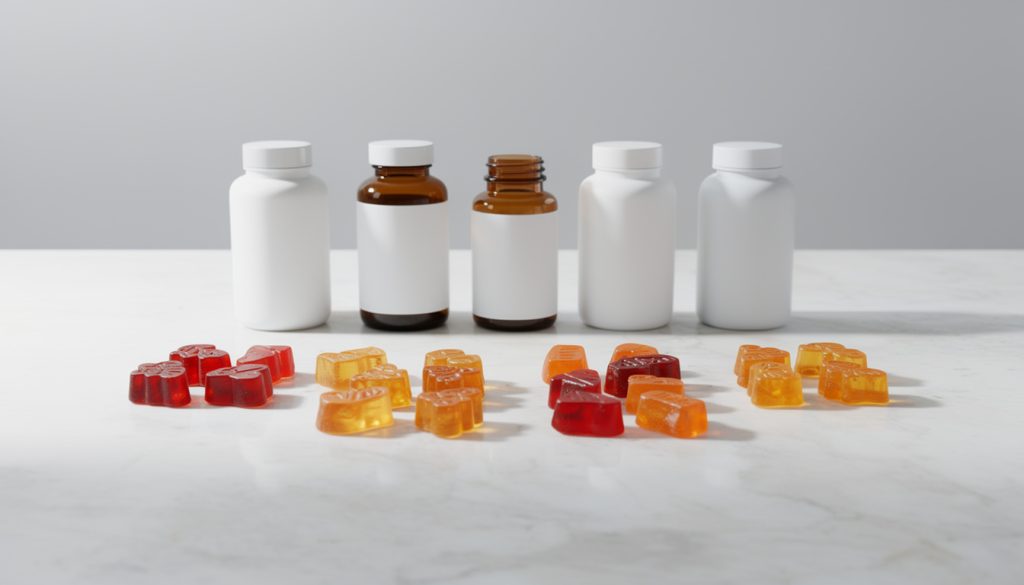
Private Label Vitamin Gummies for Retail and Ecommerce Brands are customized, chewable nutraceutical dosage forms made by specialized production partners for shelf distribution and direct-to-consumer sales. Private label vitamin gummies now sit beside tablets and capsules in nearly every supplement aisle and online storefront. This article covers formulation choices, manufacturer qualification, quality control, packaging safeguards, and cost management for brands entering the category with nutraceutical gummies.
Private Label or White Label: Where Formula Ownership Sits
White label gummies come from a stock formula that the manufacturer already runs. The brand adds its label and little else. Private label work reverses the order: the brand specifies actives, dosages, shapes, and flavor profiles, and the manufacturer builds around that brief. Brands moving into private label supplements usually do so because a stock formula looks identical to a competitor's on a crowded marketplace page.
Custom Formulation Versus Ready-to-Ship
Custom formulation gummies allow unique nutrient stacks, branded functional ingredients, and distinct sensory profiles through gummy contract manufacturing. Stock catalogs ship faster and ask for less development effort, but the formula is shared and exclusivity is limited. Custom runs take longer to launch, yet the brand typically controls the specification and the intellectual property behind it.
Pectin or Gelatin? Choosing the Gummy Base
Pectin is a citrus- or apple-derived gelling agent, and it makes certified vegan gummies possible. Gelatin is animal-derived and has been the traditional standard. The choice shapes positioning, texture, and shipping tolerance.
| Factor | Pectin gummies | Gelatin gummies |
|---|---|---|
| Source | Plant-based, supports vegan claims | Animal-based |
| Heat tolerance | Holds shape up to about 40 °C | Softens around 30 to 35 °C |
| Texture | Clean, short bite | Chewy, elastic |
| Processing | Needs tight pH and cooking control | More forgiving, thermo-reversible |
| Best fit | Clean-label, vegan, warm-climate logistics | Traditional chew, cost-sensitive lines |
Active load complicates the picture. Botanical extracts, minerals, and some vitamins can weaken gel strength or shift pH, so the gummy dosage form often caps how much active fits in one piece. Sugar-free gummies built with maltitol, xylitol, or allulose behave differently from sucrose and glucose syrup matrices, with changes in sweetness, cooling effect, and moisture handling. Natural flavors and plant-based coloring agents such as elderberry juice, beetroot powder, or turmeric extract meet clean-label retail demands, though some fade under light and heat.
What a Gummy Supplement Manufacturer Must Prove Before Signing
The brand owner carries the reputational and regulatory liability for what ships, so the vetting process matters as much as the formula. Qualification starts with documentation, then moves to an audit.
Quality Systems, Audits, and Traceability
A credible GMP manufacturing site shows filtered air handling, validated sanitation procedures, and environmental monitoring. Due diligence also covers standard operating procedures, customer complaint records, change control notifications, and the results of mock recall drills. Lot-level traceability from raw material to finished bottle should be demonstrable within hours.
Certificate of Analysis and Third-Party Testing
Every finished batch needs a certificate of analysis (COA) listing active potency, residual moisture, and pH. Safety screening covers total aerobic count, yeast and mold, Salmonella, E. coli, and heavy metals including lead, cadmium, arsenic, and mercury. Independent third-party testing adds credibility, and programs such as USP verification evaluate label claims, contaminant limits, and disintegration or dissolution performance. Retention samples held through the full shelf life support stability testing and later complaint investigations.
Common Mistakes That Make Gummies Sweat, Clump, and Lose Potency
Gummies react to their surroundings more than most dosage forms. The usual failure is a water activity mismatch: too high, and the pieces weep, grow mold, and stick together; too low, and they turn brittle and hard. Heat softens or melts the matrix, and oxygen and warmth erode vitamins. Manufacturers typically add an overage of active ingredients so that label claims hold until expiry, and shelf-life testing confirms whether the margin was enough.
Surface treatment helps. Carnauba wax, fractionated coconut oil, or acid sanding applied during tumbling reduces sticking. Packaging then carries the rest of the load. HDPE or amber PET bottles suit retail shelves, while multilayer aluminum barrier pouches block moisture and oxygen at lower weight. Hermetic induction seals, desiccant sachets, and child-resistant closures remain standard for blocking vapor transmission. Skipping any of them is the most common packaging error in new gummy launches.
From Brief to Shelf: Timelines, MOQs, and Landed Cost
Development follows a fixed order: bench trials, sensory sign-off, pilot stability batches, label regulatory review, packaging procurement, and commercial production. Pilot approval commonly takes weeks, and full-scale runs add roughly 8 to 16 weeks depending on component availability.
The minimum order quantity (MOQ) tends to be steep because depositing lines need syrup cooked in volume and flushed between flavors. Benchmarks of 5,000 to 20,000 bottles per SKU are typical. The per-unit invoice rarely tells the whole story. True landed cost adds flavor development fees, outside lab testing, packaging plates and tooling, freight, temperature-controlled warehousing, overrun tolerances, and a contingency for defects. Brands that price only the gummy often find margins thinner than projected.
Retail Shelf or Parcel Mailer: Distribution Readiness
Brick-and-mortar retail rewards shelf visibility, rigid bottles that survive handling, tamper-evident seals, and gross margins that can absorb distributor cuts. Ecommerce asks different questions: whether the pack survives a parcel drop test, whether pouch mailers keep volumetric weight low, and whether margins cover customer acquisition costs.

Heat is the shared threat. Summer parcel shipping may call for insulated mailers, gel packs, or expedited dispatch, and pectin-based formulas give more tolerance than gelatin. Warehouses rotate stock first-in, first-out and hold inventory in cool, dry conditions so that private label vitamin gummies reach customers well within shelf life. Repeat-purchase velocity, which is high for dietary supplement gummies, depends on the first bottle arriving intact.
How do white label gummies differ from private label gummies?
White label gummies use an existing stock formula with only the branding changed. Private label gummies are built to a brand's own specification for actives, dosage, shape, and flavor.
Are pectin gummies always better than gelatin gummies?
Not always. Pectin suits vegan positioning and warmer shipping conditions, while gelatin offers a chewier texture and a more forgiving production process.
Which documents verify the quality of a finished batch?
A certificate of analysis covering potency, moisture, pH, microbial limits, and heavy metals is the baseline. Independent third-party results and retained samples add further assurance.
Why do gummy MOQs run higher than those of capsules?
Gummy production requires cooking and depositing syrup in large volumes, and flushing the line between flavors wastes material. Small batches therefore carry a disproportionate cost.
About the Business
Maya Plus is a leading manufacturer of high-quality food supplement and vitamin gummies, offering private label solutions tailored to the needs of health-conscious consumers, retailers, and businesses. The company specializes in innovative gummy formulations for men, women, kids, sports nutrition, and beauty applications.